아르투어 쇼펜하우어의 모자 관계 / 유산 문제 (오늘날 관점에서 보면 그는 아무 일도 안하고 아버지의 유산 덕택에 매년 1억 3000~8000만원 정도 연봉을 받았던 것으로 보인다)
ChatGPT의 말:
Yes — the second version is essentially correct, but there is an important interruption.
After Arthur Schopenhauer left his mother's house in Weimar in May 1814, he and Johanna never saw each other again in person. The rupture was very serious. Johanna wrote him a bitter letter declaring that the door between them was closed, and Arthur moved to Dresden.
However, they did not simply stop communicating altogether in 1814.
The chronology is roughly:
- May 1814: Arthur leaves his mother's house. This is the final physical separation; he never visited her again.
- 1814–c. 1819: They apparently continued communicating by letter for a time, despite their estrangement. Their correspondence was hostile and difficult. Much of Arthur's correspondence was later destroyed, so the surviving record is uneven.
- 1819: There was another attempt at rapprochement around the family's financial crisis. Arthur offered to share his inheritance with his mother and sister after their financial losses, but Johanna rejected the offer.
- After 1819: The correspondence appears to have broken off for about twelve years.
- 1831: Arthur himself reopened communication with Johanna. From this point they corresponded sporadically.
- 1831–1838: There was therefore occasional correspondence, despite their continued estrangement. Johanna died in April 1838.
So if you're trying to phrase it precisely, I would say:
After leaving his mother's house in May 1814, Schopenhauer never saw Johanna again, but he did not permanently cease communicating with her. They continued corresponding for some years, then their correspondence broke off around 1819, and it was resumed in 1831 and continued sporadically until Johanna's death in 1838.
The key distinction is "never saw her again" ≠ "never communicated with her again." Some biographical accounts compress the story and call 1814 the "final break," which can misleadingly suggest that all communication ended then. The more detailed chronology indicates that the personal relationship ended in 1814, while the epistolary relationship continued intermittently.
One additional complication: the surviving correspondence is incomplete, because Johanna destroyed Arthur's letters to her, and some of the letters preserved by Adele were also subsequently destroyed. So we should be cautious about reconstructing exactly how frequently they communicated between 1814 and 1819.
나의 말:
ChatGPT의 말:
Yes. And the surviving evidence gives us a surprisingly concrete picture of what their renewed relationship looked like.
The important point is that their correspondence after 1831 was not a warm mother-son reconciliation in the ordinary sense. It was more like a cautious, civilized reopening of communication after seventeen years of estrangement. The surviving letters suggest that they mostly communicated about practical matters, family affairs, money, Arthur's circumstances, and Johanna's literary career, rather than trying to resolve their old emotional conflicts.
The 1831–32 reopening
Arthur was the one who initiated the renewed contact. In October 1831, after moving to Frankfurt, he wrote to his sister Adele. Adele responded with news about her own life and eventually indicated that she was willing to tell their mother about the renewed correspondence. This led to a new exchange between Arthur and Johanna in January 1832.
What's particularly interesting is that the immediate practical reason for the correspondence was financial.
There was an old family financial matter involving the Ohras estates near Danzig. The administrator, Stadtmiller, had died leaving a deficit, and there were problems involving the appointment of a new representative and the collection of rents. Johanna and Arthur had to deal with these matters together.
So their first conversations after seventeen years were, in effect, something like:
There is a financial problem involving the family property. What should we do about it?
rather than:
Let's finally talk about what happened between us.
That distinction is important.
But the tone had changed
Despite the practical beginnings, Johanna's tone toward Arthur was considerably softer than it had been in their youth.
A scholarly study of the surviving letters notes that Johanna wrote to her now 44-year-old son with advice and admonitions, but did so in a loving or affectionate tone. Arthur also wrote to her.
And there is a particularly revealing example from 1833: Arthur informed Johanna about a favorable review of the collected edition of her writings. In other words, they could now communicate about her literary reputation and his interest in her professional success.
This is significant because Johanna was by then a very successful author. Arthur had always had a complicated attitude toward his mother's literary fame, but by 1833 he was capable of writing to her about the reception of her work.
And in 1835 Arthur actually helped her
Another fascinating episode occurred in 1835.
Johanna and Arthur were connected by an old financial claim against a debtor who was not paying. Arthur intervened forcefully and managed to save the family's claim. So their relationship had become sufficiently functional that they could cooperate over money and property.
This is probably one of the clearest indications that something genuinely changed between them.
They weren't suddenly affectionate in the modern sense, but Arthur could now do something useful for his mother, and she could communicate with him without the explosive hostility characteristic of their earlier relationship.
What they apparently did not talk about
This is just as interesting.
There is no evidence that they had a great emotional reconciliation in which they sat down and discussed the events of 1813–14, their father's death, the terrible quarrels in Weimar, or Arthur's accusations against her.
In fact, the surviving evidence suggests almost the opposite.
Their relationship became civilized without becoming intimate.
The old wounds had not necessarily disappeared. Johanna did not retract the harsh treatment of Arthur, including her earlier decision to disinherit him. And Arthur continued to harbor extremely negative opinions about his mother even after her death.
So I'd characterize the later relationship as:
estrangement → cautious contact → practical cooperation → cordial but limited correspondence
rather than:
estrangement → emotional reconciliation → close relationship.
One especially interesting thing about the letters
The surviving correspondence is frustratingly incomplete. A modern scholarly edition/study reports 16 surviving letters from Johanna from this final period, but many had never been published in the older biographies; only fragments of several were previously known.
That means that older biographies can give the impression that virtually nothing happened between them after 1831, when in fact we have evidence of a modest but real correspondence.
And the fact that Arthur's letters to Johanna were not all preserved makes it difficult to reconstruct the conversation as a genuine back-and-forth. We often have Johanna's side without Arthur's corresponding letter.
So, in plain terms
If you're imagining what an exchange between them in 1832 might have looked like, it was probably much less dramatic than one might expect from their history:
- family financial problems;
- property and inheritance matters;
- advice and practical concerns;
- Arthur's circumstances and difficulties;
- Johanna's literary affairs;
- reviews of her books;
- occasional assistance with family business;
- relatively cordial personal remarks.
They had reached a kind of arm's-length civility.
And I think this is actually quite poignant: Arthur spent nearly two decades unable to tolerate his mother, but when they finally resumed contact, they didn't resolve the past—they simply learned to communicate around it.
If you want, I can also dig into the actual surviving 1832 letters and reconstruct what Johanna said to Arthur, letter by letter, including the passages that reveal how she felt about him at the end of her life.
나의 말:
ChatGPT의 말:
Yes, but there is an important distinction between Arthur's inheritance from his father and Johanna's own estate.
1. Heinrich Floris Schopenhauer's inheritance
Arthur's father, Heinrich Floris Schopenhauer, died in 1805. His estate was essentially divided into three portions: one for Johanna, one for Arthur, and one for Adele. Arthur's portion was legally his own inheritance, not something that Johanna could simply give away or revoke.
And yes, Arthur was entitled to take control of his portion when he reached the age of majority. He was seventeen when his father died, so the money was initially administered for him; when he became an adult, he obtained control of it.
So your basic understanding is correct:
Johanna did not have the power to decide that Arthur would no longer inherit the portion his father had left to him.
It was Heinrich's inheritance to Arthur, not Johanna's inheritance to Arthur.
This becomes especially important in 1819.
2. What happened in 1819?
Johanna and Adele had placed their money in the banking house Abraham Ludwig Muhl & Co. When the bank got into trouble in 1819, they lost roughly 70% of their assets through the eventual settlement. Arthur, meanwhile, had kept his father's inheritance largely separate and refused to accept the unfavorable settlement. He eventually recovered his money.
Arthur actually offered to share some of his father's inheritance with his mother and sister after their losses.
Johanna refused his offer.
And this is an important point: she couldn't take his inheritance from him simply because she was his mother. It belonged to Arthur.
In fact, Arthur managed his inheritance quite successfully. By the time Johanna died, he had apparently preserved and substantially increased his father's inheritance, whereas Adele was financially much more vulnerable.
3. But Johanna could decide who inherited her money
This is where the situation reverses.
Johanna had her own estate, consisting of whatever remained from her husband's inheritance, her earnings as a writer, property interests, etc.
And she did have the power to decide who would inherit that estate.
Her will made Adele her sole heir, deliberately leaving Arthur out.
This wasn't quite as dramatic financially as it might sound, however.
By 1838, Johanna was no longer wealthy. The 1819 banking collapse had destroyed most of the fortune that she and Adele had inherited from Heinrich. Johanna subsequently supported herself partly through her writing, but her financial circumstances became increasingly difficult. Adele herself spent much of her own remaining money helping her mother with expenses and debts.
And there's a fascinating detail concerning the final estate.
According to the surviving account of the inheritance, Johanna still possessed a one-ninth interest in the Schopenhauer family estates at Ohra near Danzig. When she died, Adele inherited that interest, bringing Adele's total share to three-ninths, while Arthur already possessed two-ninths from his father's inheritance.
Arthur could have challenged Johanna's will, but he chose not to. He essentially let Adele have what their mother had left.
So the family inheritance can be visualized like this:
Heinrich's estate (1805) Johanna's estate (1838) Arthur Inherited his own share Excluded by Johanna's will Adele Inherited her own share Johanna's sole heir Johanna Inherited her share as widow Her remaining estate passed to Adele The really crucial distinction is:
Arthur did not inherit from his father "through Johanna." He inherited directly from Heinrich.
Therefore, once Arthur's paternal inheritance became his legally, Johanna could not disinherit him from it. She could only determine what happened to her own property after her death.
And this explains something quite interesting about their later relationship: when Johanna died in 1838 and left everything to Adele, Arthur was already financially independent of her. He didn't need her inheritance. Adele, on the other hand, was in a much more precarious financial position. That's one reason historians often interpret Johanna's decision as being at least partly motivated by concern for Adele rather than simply as a final act of revenge against Arthur.
If you'd like, I can also explain exactly what Heinrich's 1805 will stipulated about Arthur's money and why Arthur couldn't access it until adulthood—because that part is quite interesting and helps explain why Arthur was already financially independent when he later broke with Johanna.
나의 말:
ChatGPT의 말:
Yes — and I should correct one detail from my previous answer: Arthur did not inherit a larger share than Johanna and Adele. Heinrich's estate was essentially divided into three roughly equal family shares: one-third to Johanna, one-third to Arthur, and one-third to Adele.
What made Arthur look much richer later was what he did with his one-third.
How much did Arthur actually inherit?
The best figure I found is remarkably precise: 19,183 thalers and 6 groschen. A contemporary/biographical account says that when Arthur reached majority in 1809, he received his share of his father's fortune, amounting to about 19,000 thalers.
So, approximately:
Arthur: ~19,183 thalers
Johanna: ~19,183 thalers
Adele: ~19,183 thalersThat would put Heinrich's distributable fortune at roughly 57,500 thalers. This is consistent with historian Rüdiger Safranski's estimate that Heinrich Floris Schopenhauer's estate was worth about 57,000 thalers in 1805.
There were also property interests, including interests in the Ohra estates near Danzig, so you shouldn't interpret 19,183 thalers as necessarily representing every asset down to the last coin.
But Arthur's share was enormous by the standards of the time
This is the really interesting part.
Arthur didn't just inherit a respectable amount of money. He inherited enough to make himself financially independent for life.
At about age 21, he had approximately 19,000 thalers invested, and the return was around 5% per year. That produced roughly 950 thalers of annual income without him working.
For comparison, a professor at the Weimar Gymnasium around 1812 earned about 600 thalers per year, while another literary figure in Johanna's circle earned only around 200–460 thalers. Arthur's investment income was therefore already greater than the salary of a respectable academic.
This is why Arthur could make the extraordinary decision to become a philosopher rather than pursue a conventional profession. He wasn't merely taking a risk with his career. His father's fortune gave him a financial safety net.
The Schopenhauer Society's chronology explicitly notes that after his mother paid out his share of the paternal inheritance in 1809, Arthur was financially independent from that point onward.
What would 19,183 thalers be in Korean won?
This is where we have to be careful, because there is no single legitimate "1809 thaler → 2026 KRW" conversion.
There are at least three different ways of asking the question:
- Silver value — what the silver contained in the coins would be worth today.
- Purchasing power — what 19,183 thalers could buy in early-19th-century Germany compared with what the equivalent amount of won buys today.
- Relative wealth — what social/economic position Arthur's fortune represented, which is probably the most meaningful measure.
If we use silver content merely as a floor/reference, the calculation is interesting. The Prussian thaler standard contained about 16.704 g of fine silver per thaler.
19,183 × 16.704 g ≈ 320.4 kg of fine silver.
Silver in Korea on August 30, 2026 was approximately ₩2,938 per gram.
So:
320,400 g × ₩2,938 ≈ ₩941 million
In other words, the silver-content value alone of Arthur's ~19,183 thalers would be roughly:
₩940 million
But I would NOT say that Arthur inherited "₩940 million in today's money." That would be misleading.
The reason is that silver was extraordinarily valuable relative to wages and goods in 1809. Arthur's fortune was not merely a pile of silver coins; it was income-producing capital. His ~950 thalers annual interest could support him at a level that the raw silver conversion badly understates.
A better way to understand his wealth
Think about it this way.
Arthur inherited:
~19,183 thalers
↓
Invested at roughly 5%
↓
~950 thalers/year
↓
A university professor earned roughly 600 thalers/year
So Arthur could receive more annual income from his investments than a professor earned from his entire profession, while not having to work at all.
And this is before considering that Arthur preserved and eventually increased his capital. By contrast, Johanna and Adele put essentially their entire fortunes into the Danzig banking house Muhl. When it collapsed in 1819, Johanna lost about 70% of her fortune.
Arthur had only about one-third of his fortune at Muhl when the collapse occurred, so he escaped the disaster comparatively well.
That difference ultimately became enormous.
So the family situation was roughly:
Person Initial share of Heinrich's estate What happened afterward Johanna ~⅓ Lost ~70% in 1819 banking collapse Arthur ~⅓ (~19,183 thalers) Preserved/increased his capital Adele ~⅓ Lost most of her financial security with Johanna And that's why, by the time Johanna died in 1838, Arthur was the financially secure one, while Adele was the vulnerable one. Johanna's decision to leave her remaining estate to Adele therefore makes considerably more sense: Arthur simply didn't need it.
One correction to your earlier formulation is therefore important: Arthur didn't "take control of the most wealth." He received one-third, just like his mother and sister. What he did was keep and grow his one-third, while the women lost most of theirs.
If you want, I can next calculate what Arthur's 950-thaler annual income would correspond to in today's Korean salary terms. That's actually much more revealing than the ₩940 million silver calculation.
나의 말:
ChatGPT의 말:
You're right. ₩940 million was a bad way to answer the question, because I treated the silver-content conversion as though it represented the purchasing power or economic status of Arthur's inheritance. It doesn't. I also used a silver figure that makes the result look deceptively small.
Let's calculate the numbers carefully.
1. Arthur's actual inheritance
The strongest source I found gives Arthur approximately 19,000 thalers at age 21, with an expected return of about 5%, or approximately 950 thalers a year.
So:
19,000 thalers × 5% = 950 thalers/year
That annual income is the really important number.
For comparison, a professor at the Weimar Gymnasium earned about 600 thalers/year in 1812. Thus Arthur's investment income alone was about 1.58× a professor's salary, without Arthur having to work.
2. Why the ₩940 million figure is misleading
The Prussian thaler of this period contained about 16.704 g of fine silver.
Therefore:
19,000 × 16.704 g = 317,376 g
= 317.4 kg of silver
At the August 30, 2026 Korean silver price of approximately ₩2,937.69/g:
317,376 × ₩2,937.69 = ₩932,? million
So yes, the raw silver calculation really is around ₩0.93 billion.
But that's not the modern equivalent of Arthur's wealth.
It is equivalent only to saying:
"If you melted the silver represented by the historical thalers and sold that silver today, you'd get roughly ₩0.93 billion."
That's a completely different question from:
"How wealthy was Arthur, in today's economic terms?"
3. The more meaningful comparison: income
Arthur's capital generated approximately 950 thalers per year.
Now compare that to the contemporary salary structure.
A professor: 600 thalers/year
Arthur's passive income: 950 thalers/year
So Arthur's inheritance generated the equivalent of about:
1.58 full professor salaries every year.
And importantly, he retained the capital.
If we want to translate that into modern Korea by income status, rather than silver, we can use a modern Korean professional salary as the benchmark.
For example, suppose we use a hypothetical ₩100 million/year professional income as a comparison:
950 / 600 = 1.583
₩100m × 1.583 = ₩158.3m/year
That would make Arthur's income roughly comparable to someone earning ₩150–160 million a year in today's Korea.
But there's an even better way to think about it.
Arthur wasn't working for that money.
He had:
~₩150–160 million/year equivalent passive income + the underlying capital.
And he was only about 21.
That is much closer to the economic reality of his position than ₩930 million.
4. What if we value the inheritance by the income it could generate today?
Suppose we take the 950 thalers/year and ask: What amount of modern Korean capital would generate an equivalent annual income?
If we assume a modern safe-ish nominal return of:
- 3%: ₩158m/year requires ₩5.27 billion
- 4%: ₩158m/year requires ₩3.96 billion
- 5%: ₩158m/year requires ₩3.17 billion
So depending on the modern return assumption, you're looking at roughly ₩3–5+ billion of income-producing wealth, not ₩940 million.
And that's still a rough comparison because modern salaries, taxation, living costs, interest rates, and asset returns aren't directly comparable to 1809.
5. And there's another important factor
Arthur's 19,000 thalers wasn't consumed.
The whole point was that it was invested capital.
If he received 19,000 thalers and earned 5%, he received 950 thalers in interest while retaining approximately 19,000 thalers of principal.
So his position was essentially:
Capital: ~19,000 thalers
Annual passive income: ~950 thalers
Employment required: noneAnd Cambridge's research explicitly emphasizes that this inheritance allowed Schopenhauer to become an "independently wealthy gentleman" and pursue philosophy without depending upon an academic salary.
So my corrected answer would be:
Arthur inherited about 19,000 thalers, roughly one-third of his father's remaining estate.
The ₩930 million figure is only the 2026 silver-metal value and seriously understates what that fortune represented economically.
A much more meaningful modern comparison is that his capital generated about 950 thalers/year, which was ~1.6× the annual salary of a professor. On a rough Korean income-equivalence basis, that suggests an income in the neighborhood of ₩150–160 million/year, backed by several billion won of capital depending on the return assumption.
So yes: Arthur was genuinely wealthy by the standards of his time—not merely "worth ₩1 billion."
And there's an even more interesting calculation we can do: track Arthur's actual fortune from 1809 → 1819 → 1838 → 1860 and convert each stage into modern KRW purchasing power. That would show just how wealthy he became relative to his mother and Adele.
나의 말:
ChatGPT의 말:
Exactly. Arthur was wealthy and financially independent, but he was nowhere near “conglomerate heir” wealth in the modern sense.
The best way to picture it is:
- Not middle class: His inheritance was large enough that he could live without employment.
- Comfortably/very affluent: The ~19,000 thalers generated roughly 950 thalers annually at 5%, which was more than the salary of a respectable professor at the time.
- Not an industrial-scale fortune: It wasn't remotely comparable to inheriting a modern Korean chaebol/conglomerate, where the family controls companies worth hundreds of billions or trillions of won.
- His great privilege was independence: Arthur could devote himself to philosophy, travel, reading, and writing without needing a career to pay his basic expenses.
There's an important nuance, though: 19,000 thalers was a substantial capital fortune in early-19th-century Germany. It could support a gentleman's lifestyle indefinitely if managed prudently. Arthur was therefore a rentier—someone living substantially from investment income rather than wages.
And this explains something about his personality and career. Arthur didn't have to ask:
"What profession will give me enough money to survive?"
He could ask:
"What do I actually want to do?"
That financial independence was one of the foundations of his ability to spend his life developing his philosophy.
So if we translate the social position rather than the coin value into modern terms, I'd describe him as something like a wealthy independently funded intellectual with several billion won of investable-wealth equivalent, rather than the heir to a Samsung/Hyundai-scale business empire.
And importantly, his father himself was a very successful merchant, not a modern corporate magnate. Heinrich's fortune was accumulated through international grain and shipping commerce, but it was still essentially a large private merchant fortune rather than ownership of a giant industrial corporation.
쇼펜하우어의 일생 – 엄마와 아들, 애증의 관계
*
요한나는 활달했을 뿐 아니라, 고전, 문학에 일가견이 있는 지적인 여성이었다.
쇼펜하우어가 학교를 그만두고 엄마 옆에 가려는 것도 이 특별한 엄마와 함께 공부하고 싶기 때문인지도 모른다.
여하튼. 20살도 안 된 청소년이 혼자 생활하기는 쉽지 않았을 것이다.
*
그러나 요한나는 아들이 온다는 소식에 치를 떨었다.
이제야 저승사자 같은 남편의 손아귀에서 벗어나 자유롭게 살면서 남자도 사귀고 글도 쓰고 싶은데,
그 남편의 복사판이 온다는 것이다.
바이마르가 프랑스와 전쟁을 벌이는 동안, 간호 자원봉사자가 되어 군인들을 치료해주고,
집 없는 사람들에게 쉼터도 제공했을 뿐 아니라,
전쟁이 끝난 후에는 지성미와 친절하고 사려 깊은 태도로
사교계에서 주목받았던 요한나가 하나 밖에 없는 아들을 왜 이렇게 싫어했는가?
일단 성격 차이가 컸다. 천성적으로 밝고 낙천적이었던 요한나는 우울하고 내성적인 아들을 이해하지 못했다.
심지어 요한나는 ‘그렇게 공부하고 싶다던 놈이.....여기 오려고 일부러 퇴학 당한거 아냐?’하고 생각했다.
요한나는 자유롭고 싶은 욕망이 가득한 나머지,
아들의 외로움, 불안, 우울증을 보살필 여유가 없었던 것 같다.
이 때문에, 요한나는 대가를 치루게 된다.
*
그 이전에 고타에서 학교를 다닐 때도 쇼펜하우어는 어머니 요한나의 집에 잠깐씩 들렀다.
그러나 이 와중에도 쇼펜하우어는 엄마가 초대한 손님들과 싸움을 벌였던 모양이다.
이 때, 쇼펜하우어가 어땠는지는 요한나가 보낸 편지를 통해 대충 짐작할 수 있다.
네놈은 똑똑하기는 한데, 심심하면 사람들한테 시비를 걸고 무시한다.
엄마는 너의 찡그린 얼굴도 보기 싫고, 재수 없는 농담도 듣기 싫다.
너랑은 성격이 너무 안맞고 말도 안통하니, 도저히 같이 못살겠다.
결국 쇼펜하우어는 어머니 요한나와 같은 집에서 살지 못하고,
요한나가 따로 마련한 하숙집에 살아야 했다. 요한나는 하숙집 문 밖에 냉정한 메모를 남겨두었다.
내 집에서 너는 손님이다. 내가 너랑 마주칠 일은 없을 것이야.
넌 매일 1시부터 3시까지만 내 집에 올 수 있어. 손님이 초대한다면, 저녁에도 올 수 있겠지.
이렇게 해야 니가 손님들과 싸우는 일이 없을 것 같다.
너한테 줄 돈은 없다. 알아서 벌어라.
*
쇼펜하우어는 이런 어머니라도 근처에 있는 것이 좋았는지, 이토록 냉정한 규칙을 2년 동안 지켰다.
그리고 어머니의 생활을 ‘냉정하게 관찰했다.’

21세의 쇼펜하우어 (수채화)
이 때, 쇼펜하우어는 공부에 박차를 가하면서 철학, 문학, 그리스어, 라틴어를 정복해갔고, 21살에는 괴팅겐 대학교에 합격했다.
예정대로 아버지 유산을 물려받았는데, 바보가 아니라면, 평생 놀고먹을 수 있는 돈이었다.
(쇼펜하우어가 물려받은 유산을 지금 돈으로 환산하면, 10억이 넘었던 것 같다.)
*
쇼펜하우어는 괴팅겐과 베를린 대학교에서 공부한 후, 예나 대학교에서 박사 학위를 받았다.
잠깐 베를린에서 지내기도 했으나 전쟁이 터지자 바이마르로 돌아왔다.
그리고는 어머니와 또 다시 전쟁을 벌인다.
쇼펜하우어는 특히 어머니 요한나의 남자 친구들을 ‘대량 생산품’ 취급하면서 맹렬하게 공격했다.
돈 문제도 있었다. 쇼펜하우어는 ‘나도 21살이 되면 아버지 유산을 물려 받아야 하는데, 돈을 그렇게 뿌려대면 어떡하냐?’고
요한나를 들볶았다. 요한나는 샌드위치 가게로 돈을 벌었고, 그 돈으로 잘 먹고 잘 사는 거 알지 않냐고 맞받아쳤다.
둘은 점점 심하게 다투었고, 집에 하숙하던 어머니의 젊은 남자 친구 게르스텐벌크(Georg von Gerstenbergk) 문제로 대판 싸운 후,
요한나는 아들을 집에서 쫓아냈다. 요한나는 아들에게 이렇게 편지를 썼다.
너랑은 같은 나라에서도 살기 싫다. 내가 아버지보다 뭐가 못해?
그래 니 갈 길을 가라. 앞으로 나한테 편지도 쓰지 마라.
*
이 때, 쇼펜하우어는 25살이었고, 그 후로는 어머니 요한나와 다시는 만나지 못했다.
이후에도 가끔 편지를 주고받았으나,
요한나는 아들 쇼펜하우어가 여동생인 딸에게 보낸 편지를 읽어보고는 인연을 끊어버렸다.
그 편지에서 쇼펜하우어는
‘우리 엄마라는 인간은 남편이 앓아누웠는데도, 나몰라라하고 잔치를 벌이면서 남편을 죽게 만든 장본인’이라고
썼기 때문이다.
쇼펜하우어는 30살에도 가족과 합치려고 했으나 실패했다. 이 때, 요한나는 은행이 부도나자 재산을 많이 잃었는데,
쇼펜하우어는 아버지로부터 물려받은 유산을 나눠주겠다고 했으나, 요한나는 아들의 호의를 거절했다.
그런데도 쇼펜하우어는 40대 후반까지 어머니와 편지를 주고받았다.
쇼펜하우어는 30살이 넘어서도 책이 전혀 안 팔리고, 대학 강사 생활도 처참하게 실패하고,
몸도 아프고, 한마디로 찹찹한 신세였다.
외로웠던지 쇼펜하우어는 다시 가족과 합치려고 했으나, 소원을 이루지 못했다.
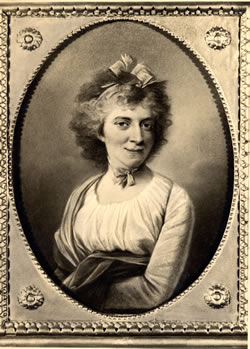
40대의 요한나 쇼펜하우어(Johanna Schopenhauer)(1766–1838)
단지히 시의원의 딸로 태어난 요한나는 18살에 20살이나 많은 남편(쇼펜하우어의 아버지)과 결혼했다.
남편이 세상을 떠나자, 요한나는 딸을 데리고 바이마르로 이사했고, 이곳에서 살롱을 열었다.
똑똑하고 글재주도 있었던 요한나는 독일에서 가명을 쓰지 않고 책을 출판한 최초의 여성이었다.
그녀는 처음에 남편과 함께 다녔던 여행 이야기를 써서 주목을 받았고,
‘가브리엘’(Gabriele)(1819), ‘단테’(Die Tante)(1823)를 비롯한 소설이 연달아 히트하면서, 독일에서 가장 유명한 여성 작가로 부상했다.
60대 중반에는 20권이 넘는 대작을 발표하기도 했다.이때까지도 쇼펜하우어는 잘해봐야 ‘요한나의 아들’에 불과했다.
그녀는 괴테, 그림 형제와 친분이 있었고, 슈베르트는 그녀의 시에 곡을 붙이기도 했다.
그러나 요안나는 강남 복부인의 한계를 벗어나지 못했다. 사치와 방탕으로 재산을 탕진해버린 요한나는
바이마르에서 버티지 못하고 본으로 이사를 갔는데,
인기가 떨어지면서 상황은 더욱 나빠졌고, 말년에는 귀족에게 연금을 구걸하는 처지로 몰락했다.
약간의 연금을 타내기는 했으나, 그 다음 해에 세상을 떠났다.
반면, 쇼펜하우어는 검소하게 살면서 평생 돈 한 푼 벌지 않고도 유산을 2배나 늘렸다.
쇼펜하우어는 어떤 측면에서 요한나보다 생활력이 강했다.
*
여러 정황을 살펴볼 때, 쇼펜하우어는 처음에 어머니의 애정을 받고 싶었으나,
피곤한 성격과 잔치집에 찬물을 끼얹는 못된 버릇 때문에 사실상 버림을 받았다고 할 수 있다.
부모의 사랑을 받지 못하고 성장한 쇼펜하우어는 사람들에게 다가가는 방법을 알지 못했던 것이다.
*
쇼펜하우어는 시간이 갈수록 아버지를 천사로, 어머니를 악마로 취급했다.
심지어 아버지가 어머니를 감시할만한 이유가 있었다고 생각했다.
반면, 아버지는 유독 찬양했는데, 유산을 물려준 탓도 있을 것이다.
쇼펜하우어는 평생 돈 한 푼 벌지 않았다.
*
바이마르에서 전쟁을 벌이는 동안, 쇼펜하우어는 박사 논문 ‘충족이유율의 네 겹의 뿌리’를 요한나에게 보여주었다.
요한나는 ‘뭐? 뿌리? 약초 말이냐?’라고 빈정댔다. 쇼펜하우어는 이렇게 응수했다.
‘당신 책은 조금 있으면 사라지겠지만, 내 책은 먼 훗날에도 사람들이 읽을 겁니다. 두고봐요.’
이 예상은 적중했으나,
어머니 요한나 덕분에 쇼펜하우어는 여성에 대해 황당할 정도로 지독한 편견을 갖게 되었다.
교회에 '여자들은 입을 다물어라'라는 경고문을 크게 써 붙이면 좋을 것이다
여자는 사리분별을 하지 못하고 사소한 일에만 관심을 가지며, 멀리 보지 못한다.
젊은 여자들은 집안일을 돌보고 남편에게 복종하도록 가르쳐야 한다.
나의 모친은 아파서 꼼짝 못하는 아버지를 하인에게 맡겨버리고, 잔치를 벌이고 신나게 놀았다.
이게 여자의 사랑이다.
- Get link
- X
- Other Apps

Comments
Post a Comment