GenCost says renewables cheaper than nuclear for future, but not all agree
https://the-riotact.com/gencost-says-renewables-cheaper-than-nuclear-for-future-but-not-all-agree/772765
GenCost says renewables cheaper than nuclear for future, but not all agree
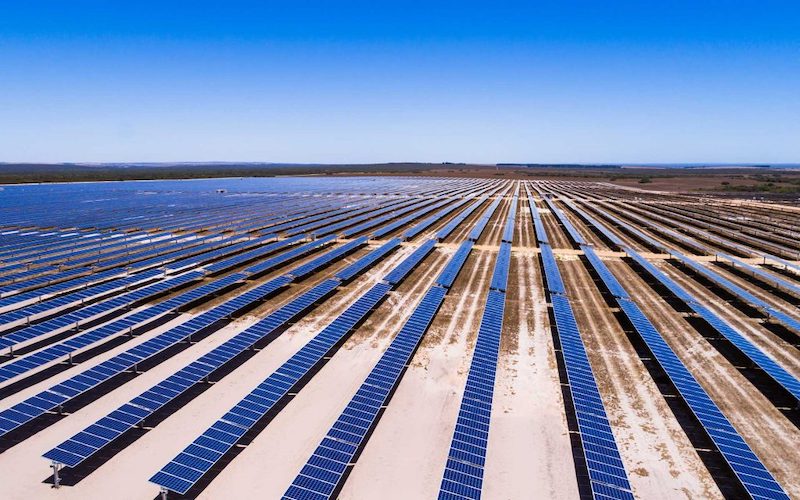
CSIRO’s latest GenCost report says renewable energy is a cheaper option than large-scale nuclear for new-build electricity technology. Photo: Australian Renewable Energy Agency.
Renewables remain the cheapest option for new-build electricity technology, says CSIRO in its latest GenCost report, which for the first time includes large-scale nuclear technology in its comparisons.
The report, prepared in collaboration with the Australian Energy Market Operator (AEMO), assessed large-scale nuclear from what it described as “the highest volume of feedback” since the GenCost’s inception in 2018 – and found it to be more costly in the journey to net-zero emissions.
In assessing the suitability of large-scale nuclear power generation in Australia’s electricity system, GenCost found while generation units of such scale were unprecedented in Australia, there were no known technical barriers.
But it also determined that nuclear power was more expensive than renewables and would take at least 15 years to develop, including construction.
This reflects the absence of a development pipeline, the additional legal, safety and security steps required, and weighing the evidence provided by stakeholders.
CSIRO’s director of energy, Dietmar Tourbier, said GenCost was committed to robust stakeholder engagement, with the latest consultation attracting more than 40 written submissions and more than 200 industry webinar participants.
“The feedback provided by the energy community each year is invaluable, given that cost forecasts of future electricity generation, storage and hydrogen production can fluctuate significantly and no single technology can achieve our transition to net zero,” Dr Tourbier said.
“Whether the input GenCost receives is highly specialised or simply advocating for a particular pathway, our considerations are policy and technology neutral.”
Reaction to the report has been as swift as it has been controversial; applauded by the renewable energy sector but criticised by advocates of nuclear power.
It comes as Opposition Leader Peter Dutton prepares to announce where he would locate seven nuclear reactors around the country.
The Institute of Public Affairs, a conservative think tank and strong advocate for nuclear energy, insists the GenCost report is misleading and built on flawed energy cost modelling.
“The CSIRO’s latest GenCost report has again relied on the discredited levelised cost of electricity methodology to calculate energy system costs,” IPA’s executive director Scott Hargreaves said.
“This gives Australians and policymakers alike a false understanding of the cost of our energy future.”
But the Clean Energy Council has welcomed the report’s findings as important data that again confirms renewables as the most affordable reliable form of electricity generation.
The council’s chief executive Kane Thornton described renewables as “the key” to achieving a cleaner, more secure future.
“This report also outlines that proposals for large-scale and small modular nuclear reactors are not a serious proposition for Australia’s energy future,” he said.
“Coal is exiting our energy system at record pace and only renewables firmed by storage can replace this generation in order to avoid blackouts and power price hikes.”
The GenCost report also revised future wind costs upwards.
It says wind power is recovering the slowest from global inflationary pressures and cost projections for onshore and offshore wind have been revised upwards in the next decade.
Despite this, updated modelling found that renewables, including costs associated with additional storage and transmission, remain the cheapest new-build technology.
Renewables retain their competitive position due to a decade of cost reductions experienced by wind, solar photovoltaics and batteries prior to the pandemic.
Costs of their “more mature competitors” have remained flat.
AEMO’s executive general manager of system design, Merryn York, said GenCost was one of several key reports to help inform the continuous design of a sustainable electricity system for Australia.
“The annual collaboration with industry to assess electricity generation costs is critical to strategic planning and policy analysis, including our integrated system plan,” Ms York said.
GenCost lead author, CSIRO’s chief energy economist Paul Graham, said assumptions, scope and methodology were adjusted in response to constructive feedback received throughout the year.
“For example, our approach to the inclusion of large-scale nuclear technology provides a logical, transparent and policy-neutral method of costing a potential deployment scenario in Australia,” Mr Graham said.
GenCost based its large-scale nuclear cost estimations on South Korea’s successful nuclear program and adjusted for differences by studying the ratio of the costs of new coal generation in each country.
The costs estimated in the report can only be achieved if Australia commits to a continuous nuclear building program, requiring an initial investment in a higher cost unit.
GenCost also found inflationary pressures had considerably eased, but with the impact inconsistent across technologies.

Comments
Post a Comment