삼극위원회 Asia Pacific Group 역사
https://www.trilateral.org/regions/asia-pacific-group/
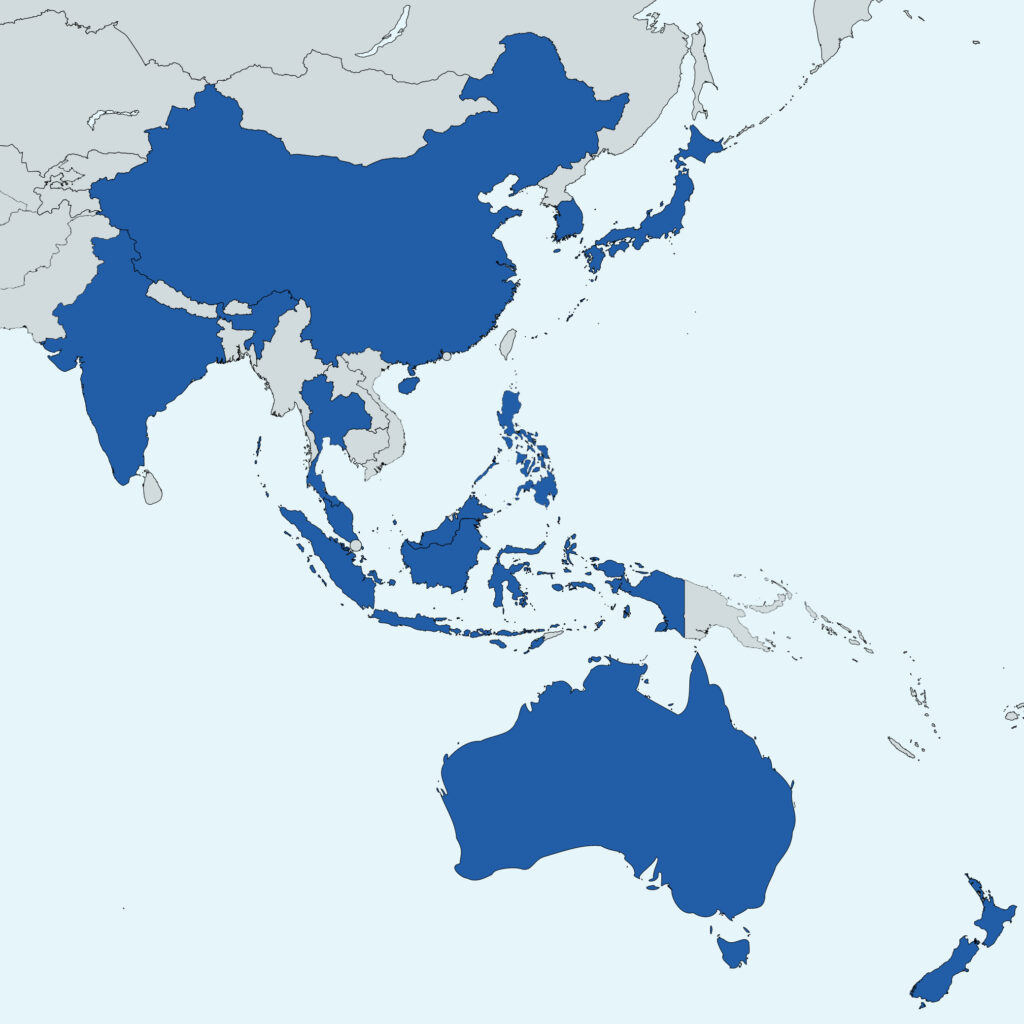
The former Japanese Group of the Trilateral Commission was widened in 2000 to become the Pacific Asian Group. For the 2009-2012 Triennium, the Pacific Asian Group is composed of about 100 members from Japan, South Korea, Australia, New Zealand, and the five original ASEAN countries (Indonesia, Malaysia, the Philippines, Singapore and Thailand), joined by the People’s Republic of China and India in 2009. Participants from Taiwan have also participated.
The first Japanese chairman was Takeshi Watanabe, who took up his Trilateral duties shortly after stepping down as president of the Asian Development Bank. The second was Isamu Yamashita, chairman of Mitsui Shipbuilding and Engineering. He was succeeded by Akio Morita, founder and chairman of the SONY Corporation. Kiichi Miyazawa, former prime minister of Japan and a leading figure in the Trilateral Commission from its beginning, became acting Japanese chairman in late 1993. He passed the baton in 1997 to Yotaro Kobayashi, then chairman and CEO of Fuji Xerox Co., Ltd., who served until 2013. He was succeeded by Yasuchika Hasegawa, Chairman of the Board of Takeda Pharmaceutical Company, Ltd., and former chairman of the Board of Keizai Doyukai (Japan Association of Corporate Executives). Takeshi “Tak” Niinami, Chief Executive Officer of Suntory Holdings, is the current Asia Pacific Chairman.
The deputy chairman for many years was Nobuhiko Ushiba, former ambassador to the United States and later minister for external economic affairs. He was succeeded by Yoshio Okawara, who had also served as ambassador to the United States. Shijuro Ogata, former deputy governor of the Bank of Japan for international affairs, succeeded Ambassador Okawara, served as deputy chairman until December 2010, and was succeeded in 2011 by Jusuf Wanandi, co-founder and vice chairman, Board of Trustees, Centre for Strategic and International Studies (Indonesia), Jakarta. Han Sung-Joo, former Korean foreign minister, became a deputy chairman of the Pacific Asian Group in 2000. After being appointed ambassador to the United States in 2003, he was succeeded by Kim Kyung-Won, president of the Seoul Forum for International Affairs and former ambassador to the United States and the United Nations. Professor Han, former president of Korea University and current chairman of of the International Policy Studies Institute of Korea (IPSIKOR), returned to the leadership of the Pacific Asian Group when he succeeded Kim Kyung-Won as deputy chairman in 2006. He stepped down in 2012 and was succeeded by Hong Seok-Hyun, chairman and CEO of Joong Ang Media Network (JMnet), Seoul, and former Korean ambassador to the United States. The group’s name was changed from Pacific Asian Group to Asia Pacific Group in 2012.
Tadashi Yamamoto, founder and president of the Japan Center for International Exchange (JCIE), was the director on the Japanese/Pacific Asian side of the Trilateral Commission from its beginning until his death in April 2012. The JCIE staff served as the Trilateral Commission’s secretariat among many other tasks. Tributes to Tadashi’s many accomplishments have come from around the world, including these from Geoge Berthoin, Henry Kissinger and David Rockefeller.
Ken Shibusawa was Tadashi Yamamoto’s successor as president and CEO of JCIE, and was also appointed the Commission’s Asia Pacific Group director. He stepped down in 2013 and was succeeded by Hideko Katsumata, Executive Director and Chief Operating Offier of JCIE. The current Asia Pacific Director is Masahisa Ikeda, Head of Tokyo Office and Global Co-Head of Sector Strategy, A&O Shearman. From January 2025, the International House of Japan has taken over as the Secretariat of the Asia Pacific Group.
The Asia Pacific Group held their first regional conference in Seoul, South Korea, in November 2000. Subsequent regional meetings were held in Hong Kong (2001), Singapore (2002), Tokyo (2003), Bangkok (2004), Beijing (2005), Bali, Indonesia (2006), Singapore (2007), Shanghai (2008), Seoul (2009), Tokyo (2010), Bali (2011), Hong Kong (2012), Manila (2013), Tokyo (2014), Singapore (2015), Delhi (2016). Tokyo (2017), Beijing (2018), Seoul (2019), Tokyo (2022), Seoul (2023), and in Manila (2024).

Comments
Post a Comment